The industrial real estate sector in Singapore is set for big growth in 2025. This is thanks to changes in the economy and strong investments in important areas. The world has seen a new normal since the pandemic, with higher growth, inflation, and interest rates.
Investments in energy, supply chains, defense, and AI are driving this growth. Singapore is expected to grow faster in 2025 than in 2023. The commercial real estate industry is feeling hopeful, with 88% of global respondents expecting more revenue in 2025.
Singapore is a key player in global trade and logistics, thanks to its strong manufacturing. This makes its industrial real estate market look promising for 2025. Despite economic and political challenges, Singapore’s strong economy and business-friendly policies attract investors.
Key Takeaways
- Singapore’s industrial real estate market is poised for growth, driven by macroeconomic shifts and investments in key sectors.
- The country’s strong trade, logistics, and manufacturing capabilities make it an attractive destination for industrial investments.
- Global GDP growth projections and industry optimism point to a positive outlook for Singapore’s commercial real estate industry in 2025.
- Opportunities exist in energy transition, supply chain restructuring, defense spending, and AI applications within the industrial real estate sector.
- Navigating economic uncertainties and geopolitical tensions will be crucial for the continued success of Singapore’s industrial property market.
Overview of Singapore’s Industrial Property Market
Singapore’s industrial property market has shown great strength and flexibility. It has faced global economic challenges head-on and performed well. The country’s strategic location and business-friendly policies draw a wide range of properties. From traditional warehouses to modern industrial parks, the market is diverse.
Recently, there’s a move towards greener and more advanced industrial spaces. Property Developers and Property Management companies are keeping up with these changes. They aim to meet the evolving needs of the market.
Singapore’s Real GDP grew 2.7% year-on-year in the first quarter of 2024. The unemployment rate rose to 2.1% in March 2024. The Industrial Property Market remains a key player, with a total industrial stock of 570.5 million square feet (sq ft) in the first quarter of 2024.
Single-user factory space makes up 49.6% of the total. This shows the market’s focus on specific needs.
The Industrial Property Market in Singapore has seen a lot of investment activity. Deals over S$100 million were common in 2023. The market is set to grow, with over 41.2 million sq ft of Gross Floor Area (GFA) to be added by 2027.
The government’s efforts to boost the Industrial Property Market have made it more appealing. This has attracted Property Developers and investors from around the world.
Key Drivers of Industrial Property Demand
The demand for industrial property in Singapore is driven by several factors. These include the growth of e-commerce and logistics sectors. Also, the focus on supply chain resilience and the expansion of high-tech industries play a role.
The government’s push for digitalization and Industry 4.0 has also boosted demand. This is for smart industrial spaces. Singapore’s role as a regional hub for various industries attracts multinational companies. This further fuels demand for industrial real estate.
Industrial assets in Singapore have seen strong growth. The JTC All Industrial price and rental indices have shown growth for eleven consecutive quarters. They reached their highest levels since Q1 2016 and Q1 2015 respectively.
Overall industrial rents have grown by 14.5% since Q3 2020. The warehouse segment has outperformed at a growth rate of 15.9% during the same period.
The vacancy rate for private warehouse space in Q2 2023 was 8.5%. This is higher than the lowest post-pandemic level of 7.8% in Q4 2022. However, it is still below the five-year average of 10.1%.
Business park spaces in the Punggol digital district and parts of the revamped Singapore Science Park are projected to add over 4.1 million square feet by 2025. A surplus of 4.5 million square feet of business park space is expected up to 2025. This could potentially moderate rental and price growth in the near term.
The industrial sector is expecting higher supply with an average of 10.1 million square feet from 2024 to 2026. This will provide more options for occupiers. Singapore remains the top destination for cross-border industrial investments in Southeast Asia. This is due to its stability, connectivity, infrastructure, and government support.
Major Industrial Areas in Singapore
Singapore’s industrial zones are strategically located and well-planned. They cater to specific industries with specialized infrastructure. Key hubs include Jurong Industrial Estate, Tuas Biomedical Park, and Seletar Aerospace Park.
Jurong Industrial Estate covers over 2,500 hectares. It’s equipped with logistics and warehousing facilities. It offers easy access to transportation networks, attracting manufacturing and logistics companies.
Tuas Biomedical Park is in western Singapore. It’s a hub for life sciences and biomedical industries. Over 60 biotech companies and research institutes, like Biopolis, call it home.
Seletar Aerospace Park is in northeastern Singapore. It’s dedicated to aviation and aerospace. It has facilities for high-tech industries like nanotechnology and electronics.
The government plans industrial land use strategically. This ensures a balanced distribution of properties across Singapore. Each zone has its unique features and target industries, offering diverse options for investors and businesses.
Investment Opportunities in 2025
Singapore’s industrial Real Estate Investment sector is set to boom in 2025. The global economy’s recovery means investors can find great deals in logistics, data centers, and high-tech parks. There’s also a chance to invest in sustainable and smart buildings, adding value to older properties.
The government is focusing on new sectors like biomedical sciences and clean energy. This could lead to unique investment opportunities in specialized facilities.
Property Prices in Singapore are expected to go up by about 3% in 2025. The city-state has one of the highest home ownership rates at 89.7%. The average HDB flat price is $597,297, or $582.04 per square foot. Condominium units average $1,945,523, or $1,880.78 per square foot.
Investors should watch the Core Central Region (CCR). Luxury properties there saw a 4.43% price jump in Q1 2024. New units in 2024 could ease price pressure.
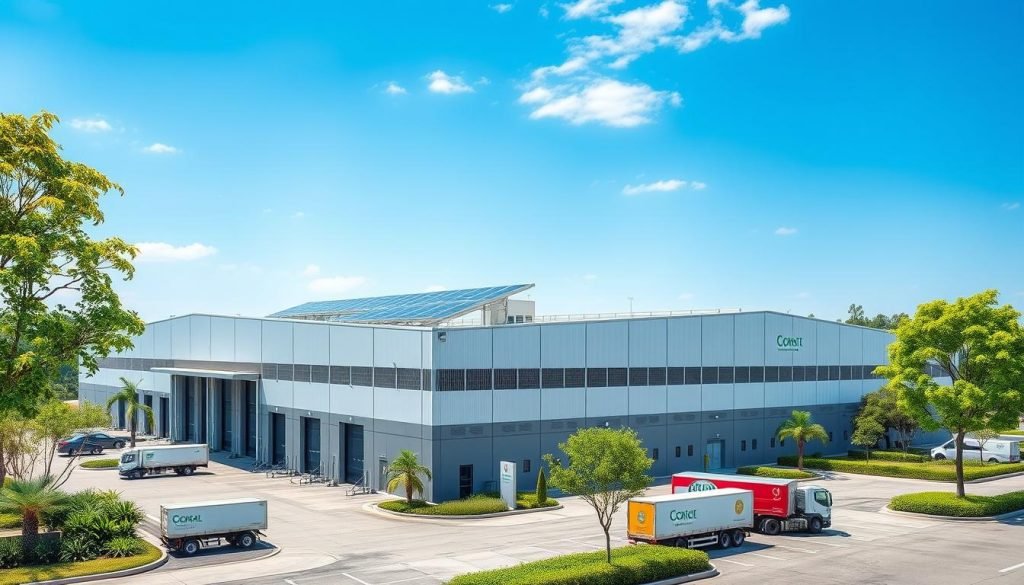
Investors are drawn to mixed-use developments for their connectivity and amenities. These offer higher rental yields and better urban living. Properties in prime spots like Orchard Sophia in the CCR cost between SG$2,758 to SG$2,895 per square foot.
The government’s support and growing demand for real estate services mean Singapore’s industrial sector will keep growing. This makes it a great time for investment.
The Role of Sustainability in Industrial Real Estate
Sustainability is key in Singapore’s industrial real estate. The government aims to cut carbon emissions by 2030. This push for green properties is driving demand for eco-friendly buildings.
Investors and developers are now focusing on green certifications and energy-efficient designs. They’re also using sustainable materials. This trend is set to grow in 2025, making sustainability a major factor in property value and tenant choices.
By end-2023, over 4,600 buildings in Singapore met the BCA’s Green Mark standards. This shows a big push for Sustainable Buildings. The built environment sector used 60% of energy in 2022, showing the need for green Industrial Properties and Property Management.
Getting green certifications can cut down on operating costs. This is because of lower utility bills. Sustainable materials, like recycled steel and bamboo, help reduce natural resource use and emissions.
Upgrading to energy-efficient systems, like variable-speed motors, can save energy. LED lighting also helps control temperature and cut down energy use. Meeting the Singapore Green Plan 2030’s goals can make properties more attractive and valuable.
Impact of Global Supply Chain Trends
Global supply chain trends are changing Singapore’s industrial real estate market a lot. The need for resilient supply chains and nearshoring is boosting demand for storage and distribution spaces. Singapore’s role as a global logistics hub is drawing in investments for advanced warehousing and distribution centers.
The growth of e-commerce is also driving demand for facilities for last-mile delivery. These trends will likely change the industrial property scene in 2025 and later. Companies are looking to find new trading partners to lower risks and make supply chains more efficient and cost-effective.
Investment is expected to grow in improving supply chain planning with advanced digital tools. Many supply chain managers struggle with visibility in long supply chains. This highlights the need to use technology and automation to reduce risks.
The effects of global Supply Chain Logistics, Industrial Property Demand, and Real Estate Investment trends will be big in shaping Singapore’s industrial real estate market in the next few years.
Technology and Innovation in Industrial Spaces
In Singapore, the industrial real estate market is changing fast. This is thanks to new technologies like the Internet of Things (IoT), Artificial Intelligence (AI), and robotics. These smart industrial buildings meet the needs of today’s manufacturing and logistics.
Property developers are leading this tech revolution. They add advanced systems and smart automation to their projects. The need for data centers and high-tech facilities is growing. Businesses want to use digital tools to make their operations better and more efficient.
The government is also pushing for Smart Industrial Buildings, Property Management, and Tech-Enabled Spaces in Singapore. Programs like the National Robotics Programme and the RIE 2025 plan provide funding for these technologies. This helps bring the latest tech to the industrial sector.
With these new technologies, the Singapore industrial property market is set to change. Developers who mix innovation with sustainability will stand out. They will meet the needs of today’s businesses and shape the future of industrial real estate in Singapore.
The Influence of Urban Redevelopment
Singapore’s industrial scene is changing fast thanks to the government’s urban plans. Older industrial spots are being turned into lively, mixed-use areas. This change brings new chances for creative industrial spaces, like vertical factories and combined industrial-commercial projects.
The Housing and Development Board (HDB) started in 1960, helping over 80% of people live in public housing. Rules like the Additional Buyers Stamp Duty (ABSD) and the Total Debt Servicing Ratio (TDSR) help keep the property market stable. They also support long-term growth.
The Urban Redevelopment Authority (URA), set up in 1974, is key in shaping Singapore’s urban area. The Concept Plan and Master Plan guide the city’s growth. The Government Land Sales (GLS) program controls land to affect prices and support green urban planning. As developers adjust to these changes, they’re finding new ways to meet business and resident needs.
Financing and Investment Considerations
The industrial property market in Singapore is changing fast. Investors need to think carefully about their plans. With interest rates likely to stay the same, getting loans might be easier in 2025. The market’s strength during tough times also makes it more appealing to big investors.
Looking into industrial real estate investment in Singapore? You must do your homework. Look at lease deals, the quality of tenants, and what the property offers. Also, keep an eye on laws, taxes, and the rules that govern everything.
Investment strategies might need to change with the market. There could be chances to add value or find new areas to invest in. The government’s help for Singaporeans might also influence your choices.
Having a diverse portfolio and expert advice can help reduce risks in industrial real estate. Keep up with new loan options, rules, and trends. This way, you can make the most of the changing industrial property scene.
Government Initiatives Supporting Industrial Growth
The Singapore government is key in growing the industrial sector. It uses targeted initiatives to boost innovation, productivity, and sustainability. This is across major industrial areas.
The Industry Transformation Maps and the Research, Innovation and Enterprise 2025 Plan are major programs. They aim to improve productivity, encourage tech use, and support green practices in industries.
The government is also investing in new industrial parks and upgrading old ones. For example, the SG Eco Fund gives S$50 million for green projects. The Enterprise Sustainability Programme will help 6,000 companies reduce their environmental impact with up to S$180 million.
Initiatives like the Maritime Singapore Green Initiative and the Built Environment Accelerate to Market Programme are also in play. They focus on innovation and sustainability in different sectors. These programs offer funding and support to help businesses grow.
The government’s efforts are set to open up new chances for industrial real estate in 2025. By creating a good environment for industries, Singapore aims to be a leader in new industrial solutions and green practices.
Challenges Facing the Industrial Property Sector
Singapore’s industrial property sector looks promising but faces several hurdles. One major issue is the risk of oversupply in some areas. This is due to competition from other regions for manufacturing and logistics.
Global economic changes and shifts in trade patterns also pose risks. These can affect demand for industrial spaces. The sector must keep up with technological advancements like automation and digitalization.
Recent data shows industrial prices and rents in Singapore have risen. They’ve grown by 20.8% and 22.5% since Q4 2020. Yet, this growth is slower than the surge seen between 2004 and 2008.
Despite these obstacles, the sector remains strong. The Manufacturing Purchasing Manager’s Index was at 51 points in September. This shows 13 months of growth. To keep thriving, the sector must manage risks, optimize property management, and tackle industrial real estate challenges.
Future Outlook for Industrial Real Estate in Singapore
The future of industrial real estate in Singapore looks bright. The country’s strong economy, strategic location, and business-friendly policies will help. Trends like high-tech growth, sustainability, and changing logistics will shape the market in 2025 and beyond.
Reports show the JTC All Industrial rental index in Singapore kept growing for the fifteenth straight quarter in Q2 2024. Rental rates rose by 1.0% from the last quarter, but slower than before. The price index for industrial real estate also went up by 1.2% from the last quarter, ending a decline.
Despite some hurdles, the industrial property sector is ready for more growth. The government’s support and the sector’s flexibility make it attractive to investors. Colliers predicts slower rent and price growth in 2024, but still sees opportunities for investment.